 Iasora
Baby weight and height by age: the WHO chart and how to read it
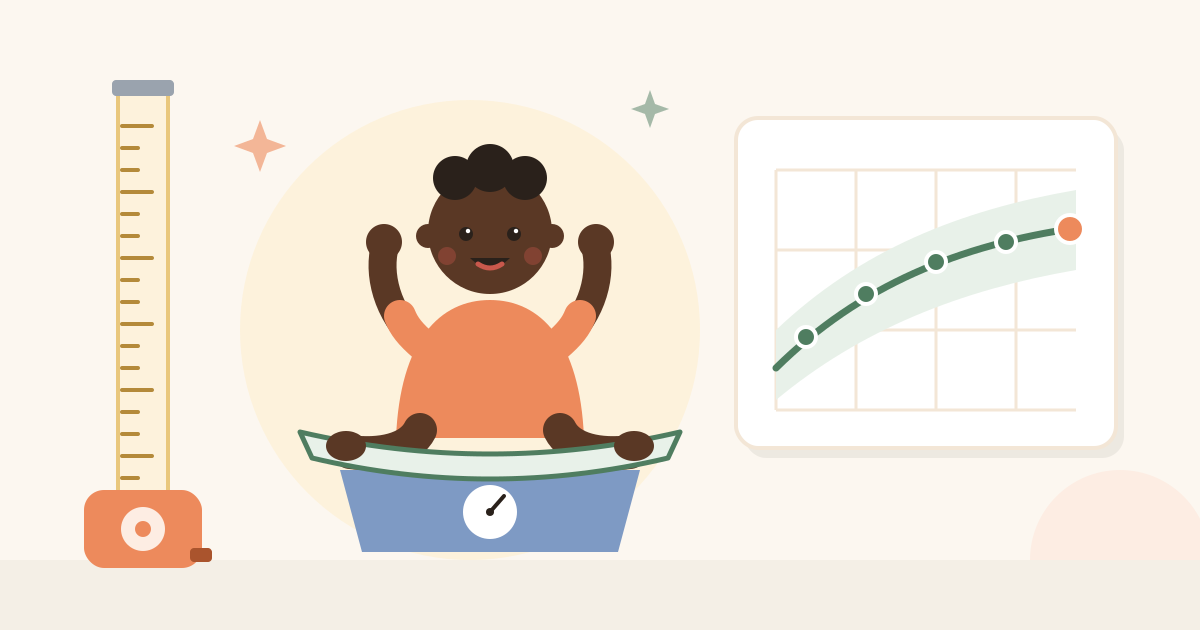
In short: according to the WHO, the average baby boy weighs 3.3 kg at birth and the average girl 3.2 kg; at 12 months the averages are 9.6 kg and 8.9 kg. But one number on its own tells you little. What matters is the curve on the growth chart in the Road to Health Book: a baby who keeps following their own line is growing well, even if they are smaller than average. The worry is a baby who stops gaining, drops down across the lines, or falls below the bottom line of the chart.
Go to the clinic or casualty straight away if your baby or child:
- Has swelling of both feet (pressing with a finger leaves a dent).
- Is very thin, with ribs and bones showing.
- Cannot breastfeed or eat, or vomits everything.
- Is floppy, has no energy or no interest in playing.
- Has diarrhoea and is losing weight, or shows signs of dehydration (dry mouth, crying without tears, very few wet nappies).
- Is a newborn who has not got back to birth weight by 3 weeks, or feeds poorly and sleeps nearly all the time.
If the nurse measures the upper arm with the coloured MUAC tape and it reads red, that means severe malnutrition and your child needs treatment the same day. In an emergency, call 10177, or 112 from a cellphone.
Average baby weight by age (WHO chart)
The growth charts used around the world, including in South Africa, come from a WHO study of more than 8,000 breastfed children in six countries — Brazil, Ghana, India, Norway, Oman and the USA — raised in good conditions. They show how a child should grow, and the WHO says they apply to all children everywhere, whatever their background.
The table shows the average (the middle line on the chart) and the −2 line. Below the −2 line, the WHO counts a child as underweight for their age.
| Age | Boys: average | Boys: −2 line | Girls: average | Girls: −2 line |
|---|---|---|---|---|
| Birth | 3.3 kg | 2.5 kg | 3.2 kg | 2.4 kg |
| 3 months | 6.4 kg | 5.0 kg | 5.8 kg | 4.5 kg |
| 6 months | 7.9 kg | 6.4 kg | 7.3 kg | 5.7 kg |
| 9 months | 8.9 kg | 7.1 kg | 8.2 kg | 6.5 kg |
| 12 months | 9.6 kg | 7.7 kg | 8.9 kg | 7.0 kg |
| 18 months | 10.9 kg | 8.8 kg | 10.2 kg | 8.1 kg |
| 2 years | 12.2 kg | 9.7 kg | 11.5 kg | 9.0 kg |
Going by the WHO figures, a baby almost triples their birth weight in the first year. After that growth slows: between the first and second birthday, the average child gains about 2.5 kg.
Average baby length by age
Until age 2, babies are measured lying down, so we talk about length rather than height.
| Age | Boys: average | Girls: average |
|---|---|---|
| Birth | 49.9 cm | 49.1 cm |
| 3 months | 61.4 cm | 59.8 cm |
| 6 months | 67.6 cm | 65.7 cm |
| 9 months | 72.0 cm | 70.1 cm |
| 12 months | 75.7 cm | 74.0 cm |
| 18 months | 82.3 cm | 80.7 cm |
| 2 years | 87.8 cm | 86.4 cm |
A child who is very short for their age may be stunted — the result of months of not enough food or repeated illness. You can't see stunting in one weighing; you see it in the length curve over time.
What the lines on the growth chart mean
The average is not a target. Half of all healthy babies are below it and half above. The lines on the chart (health workers call them centiles or z-scores) show where your child sits compared with other children of the same age and sex.
- Between the −2 and +2 lines: where most healthy children are.
- Below −2: underweight. Worth discussing with the nurse.
- Below −3: severely underweight. Needs assessment at the clinic.
- Above +2: possibly overweight — also worth discussing, especially after the first year.
Why the trend matters more than one number
A baby who was born small and keeps growing along the same line is doing well. A baby who was born big and starts drifting down from one visit to the next may be getting ill or not eating enough — even if they still weigh more than average.
Signs on the chart worth raising with the nurse:
- The line goes flat: no weight gained between visits.
- The line drops: your baby has lost weight.
- The line crosses down through one or more of the printed lines.
- The line shoots up quickly, crossing lines upwards.
A single weighing can mislead — a different scale, a wet nappy, a baby who is ill that day. That's why weighing at every visit and plotting the dot in the book matters so much.
My newborn lost weight in the first days — is that normal?
Yes. All newborns lose some weight in the first week, mostly fluid. Around day 5 they start to gain again, by about 2 weeks most are back to birth weight, and almost all have regained it by 3 weeks. After that, a newborn gains close to 28 grams a day.
If your baby feeds poorly, sleeps nearly all the time, has few wet nappies or hasn't got back to birth weight, don't wait for the next appointment — go to the clinic.
Malnutrition: what to look out for
The WHO describes three forms of undernutrition in children:
- Wasting: low weight for length. It comes on fast, often after diarrhoea or another illness.
- Stunting: short for age, after months of poor nutrition or repeated infections.
- Underweight: low weight for age — it can be either, or both.
The signs of severe malnutrition — swollen feet, a very thin child, no energy, no appetite — are in the red box at the top. A malnourished child catches infections more easily, and a bout of diarrhoea can quickly become dangerous. Read more in diarrhoea and dehydration in children.
Overweight counts too
A chubby baby is not automatically a healthier baby. If the curve climbs above the +2 line and keeps climbing, talk to the nurse. Babies and toddlers don't need juice, fizzy drinks, chips or sweets.
How feeding helps your baby grow well
The WHO and UNICEF recommend:
- Breastfeeding within the first hour after birth.
- Only breast milk for the first 6 months — no water, tea or porridge.
- From 6 months, safe and nutritious solid foods alongside breast milk, becoming more varied over time.
- Breastfeeding up to 2 years or beyond.
When your child is ill, keep breastfeeding and keep offering food. If they've lost weight, ask the nurse how to help them catch up.
The growth chart in the Road to Health Book
The Road to Health Book you get at birth has the growth chart. At each visit the nurse weighs your baby and plots a dot; joining the dots shows your child's line. The book also records vaccines, vitamin A and deworming.
- Take the book to every visit, including vaccine visits (see the South Africa vaccination schedule).
- Ask the nurse to show you the curve and explain whether the line is going up well.
- Take a photo of the growth chart page after each visit.
An app like Iasora can keep a record of each weight and length so you can see the trend, but it's the health worker who assesses your child's growth.
Sources
- Child growth standards — Weight-for-age (z-score tables, 0 to 5 years) — WHO
- Child growth standards — Length/height-for-age (z-score tables, 0 to 2 years) — WHO
- Child growth standards — Questions and answers — WHO
- Infant and young child feeding — fact sheet — WHO
- Malnutrition — fact sheet — WHO
- Your Baby's First Month: Growth & Physical Appearance — AAP — HealthyChildren.org
- Early days (after the birth) — NHS
- Know who you can call in an emergency — Western Cape Government
This article is general information, written by the Iasora team from the sources above. It does not replace a consultation or the judgement of a health worker who sees your child. If in doubt, go to your nearest clinic.