 Iasora
Diarrhoea in children: ORS, zinc and the signs of dehydration
In short: diarrhoea means 3 or more loose or watery stools in a day. The danger is not the runny tummy itself but dehydration — losing water and salts. Start at home straight away: ORS after every loose stool, more breastfeeds, normal food, and zinc for 10 to 14 days. If your child can't drink, is floppy or drowsy, or has blood in the stool, go to the clinic or casualty now.
Go to casualty now, or call an ambulance (10177, or 112 from a cellphone), if your child with diarrhoea:
- Can't drink or breastfeed, or is drinking very little.
- Vomits everything, or the vomit is green, bloody or looks like coffee grounds.
- Is very floppy, drowsy, hard to wake, or has had a fit.
- Has sunken eyes, or the skin of the tummy goes back slowly when pinched.
- Has blood in the stool.
- Is a baby under 12 months and you are worried.
- Has a fever after being in a malaria area (Limpopo, Mpumalanga, northern KwaZulu-Natal, Mozambique and neighbouring countries) — malaria can look like a tummy bug.
- Is getting worse, or the diarrhoea has lasted 14 days or more.
On the way, keep giving sips of ORS and keep breastfeeding.
How many times a day counts as diarrhoea?
The WHO defines diarrhoea as 3 or more loose or watery stools in 24 hours, or more often than is normal for that child.
- Breastfed babies normally have soft, yellow, pasty stools. That is not diarrhoea. Worry if they suddenly become much more frequent or watery.
- Formed stools several times a day are not diarrhoea either.
Most diarrhoea clears up within 5 to 7 days, and vomiting usually stops within 1 or 2 days. Worldwide, diarrhoea is still one of the leading causes of death in young children — almost always through dehydration, which simple steps started early can prevent.
Signs of dehydration: how to tell if it's serious
Clinic nurses use the WHO's IMCI (Integrated Management of Childhood Illness) classification. You can look for the same signs at home:
| What you see | What it means | What to do |
|---|---|---|
| Two or more of: floppy or unconscious; sunken eyes; can't drink or drinks poorly; skin pinch goes back very slowly (more than 2 seconds) | Severe dehydration | Casualty now. Sips of ORS on the way. |
| Two or more of: restless and irritable; sunken eyes; drinks eagerly, very thirsty; skin pinch goes back slowly | Some dehydration | Clinic today. They give ORS over 4 hours and check again. |
| None of these signs | No dehydration | Treat at home (the four rules below) and keep watching. |
For the skin pinch: gently pinch the skin of the tummy, beside the belly button, between two fingers, then let go. Normally it springs straight back.
Other things to notice: a dry mouth and tongue, crying without tears, and fewer wet nappies or much less wee.
The four rules for treating diarrhoea at home
These are the IMCI home-treatment rules for a child with no dehydration — and what the clinic will tell you once it has treated dehydration.
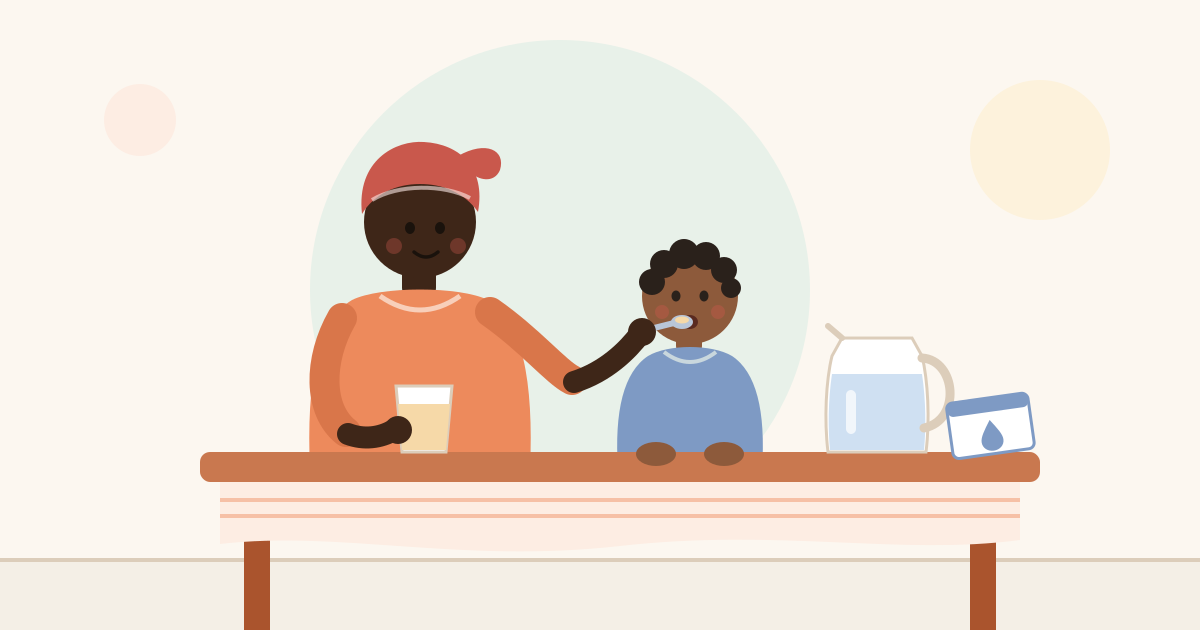
- Give extra fluid, especially ORS.
- Give zinc for 10 to 14 days.
- Keep breastfeeding and feeding.
- Know when to go back.
1. How to make up ORS
- Wash your hands with soap and water.
- Use clean water. If you're not sure it's safe, boil it and let it cool.
- Mix the whole sachet into exactly the amount of water written on the packet (the standard WHO sachet is for 1 litre). Don't add extra water or sugar.
- Stir, cover and keep somewhere cool. Throw away what's left after 24 hours and make a fresh batch.
Ask your clinic or pharmacist for ORS sachets. Keeping one or two at home is a good habit.
How much ORS to give
According to IMCI, on top of what your child usually drinks, give after each loose stool:
| Age | Amount after each loose stool |
|---|---|
| Up to 2 years | 50 to 100 ml (a quarter to half a cup) |
| 2 years and older | 100 to 200 ml (half to a full cup) |
- Give small, frequent sips from a cup or spoon, not a bottle.
- If your child vomits, wait 10 minutes, then carry on more slowly. One vomit doesn't mean the ORS isn't working.
- Keep going until the diarrhoea stops.
No ORS in the house?
Start with what you have: breast milk, soup, rice water, yoghurt drinks or clean water — the home fluids IMCI recommends — and get ORS from a pharmacy or clinic as soon as you can.
Don't try to guess a sugar-and-salt mix unless a health worker has shown you how: too much salt can be harmful. Avoid fizzy drinks, fruit juice and sports drinks, which have the wrong balance of sugar and salt and can make diarrhoea worse.
2. Zinc for 10 to 14 days
The WHO and UNICEF recommend zinc for every child with diarrhoea: 10 mg a day for babies under 6 months and 20 mg a day from 6 months, for 10 to 14 days. Your clinic or pharmacist will give it as a tablet that dissolves in a little breast milk, ORS or clean water.
Zinc shortens the episode and lowers the chance of more diarrhoea over the next 2 to 3 months. Finish the full course, even if the diarrhoea stops sooner.
3. Keep breastfeeding and feeding
- Breastfeed more often and for longer. A baby under 6 months who is exclusively breastfed stays on breast milk, with ORS or clean water on top.
- Formula-fed babies keep having formula at its normal strength — don't water it down.
- Older children carry on with their usual food, in smaller amounts more often. The old "BRAT" diet (bananas, rice, apple, toast only) is no longer recommended.
- Once the diarrhoea is over, offer more food than usual for a while to make up lost weight.
- Don't starve a child "to rest the tummy" — it only weakens them.
4. When to go back
Go back straight away if any sign from the red box appears, if your child gets worse, stops drinking, develops a fever or passes blood. If the diarrhoea isn't improving after 5 days, go back for a check.
Medicines to stop diarrhoea: no
The WHO advises against anti-diarrhoeal medicines for children, and the NHS says not to give them to children under 12. They don't treat the cause and can be dangerous. Antibiotics only help in specific cases (such as blood in the stool or cholera) and only when a health worker prescribes them. Also avoid purges, enemas and herbal mixtures that make a child lose even more fluid.
Blood in the stool
Diarrhoea with blood is called dysentery. It always needs to be seen at a clinic, because your child may need an antibiotic. Keep giving ORS and breastfeeds while you go.
Cholera and travel
Cholera causes severe, watery diarrhoea that can kill within hours without treatment. Outbreaks happen in the region, including in Mozambique. If your child develops a lot of watery diarrhoea during or after travel, or there's an outbreak where you live, start ORS and go to a clinic or casualty without waiting. Most people with cholera recover well with ORS given in time.
How to prevent diarrhoea
- Wash hands with soap and water after the toilet, after changing nappies, and before preparing food or feeding your child.
- Safe water: if your tap water isn't reliable, boil drinking water and store it covered.
- Exclusive breastfeeding for the first 6 months — no water, tea or porridge.
- Cook food well, serve it hot and store leftovers covered.
- Keep a child with diarrhoea or vomiting home from crèche or school until 2 days after the last episode, and clean toilets and taps daily.
- Rotavirus vaccine: rotavirus is a common cause of severe diarrhoea and vomiting in babies. In South Africa it's given by mouth at 6 and 14 weeks as part of the routine EPI-SA schedule. Check your child's Road to Health Book, and see the South Africa vaccination schedule.
What to tell the nurse or doctor
It helps to know: how long the diarrhoea has lasted, how many times a day, whether there's blood or vomiting, how much your child is drinking and weeing, whether there's a fever, and any recent travel. Bring the Road to Health Book. For other warning signs, see danger signs: when to take your child to hospital.
Sources
- Diarrhoeal disease — fact sheet — WHO
- Clinical management of acute diarrhoea: WHO/UNICEF joint statement (WHO/FCH/CAH/04.7) — WHO and UNICEF
- Integrated Management of Childhood Illness — Chart booklet (March 2014) — WHO (IMCI)
- Oral rehydration salts (ORS) — Essential drugs — Médecins Sans Frontières — Medical Guidelines
- Rotavirus — Communicable Diseases Communiqué (June 2022) — NICD
- Cholera — fact sheet — WHO
- Diarrhoea and vomiting — NHS
- Diarrhea in Children — AAP — HealthyChildren.org
- Know who you can call in an emergency — Western Cape Government
This article is general information, written by the Iasora team from the sources above. It does not replace a consultation or the judgement of a health worker who sees your child. If in doubt, go to your nearest clinic.